Functional Medicine
You may have seen several specialists about your autoimmune disease or symptoms, and still feel that no one has looked at everything together. An autoimmune diagnosis tells us what condition you have, but it doesn’t always explain the full picture. This is where we can help.
Rather than looking at a single diagnosis or one system in the body, we bring together all the available information to build a more complete understanding of your health. This often helps people better understand why symptoms fluctuate, why they may continue despite treatment, and what areas of your health may benefit from further attention.
We can see you wherever you are in the UK.
We provide treatment for autoimmune diseases and immune-mediated conditions alongside your NHS or private specialist.
We recognise the important role that conventional medicine plays in the diagnosis and management of autoimmune conditions. However, many people benefit from looking beyond symptom management alone to better understand the wider biological factors influencing their health. We use a functional medicine approach to do this.
You may have symptoms without a clear diagnosis, have been told your test results are normal but still don’t feel well, or have an autoimmune diagnosis but continue to experience ongoing symptoms despite treatment, we can help you.
Functional medicine is a well established medical approach that aims to understand why symptoms have developed and why they continue, rather than only focusing on symptom management alone. We look at the immune system alongside other systems in the body and how they are interacting with one another and affecting your health.
We also support people with related complex chronic conditions that may coexist with autoimmune disease. These commonly include:
Our GMC-registered doctors bring together your symptoms, medical history, previous investigations and functional testing to understand what may be contributing to your symptoms.
The most valuable insights often come from looking at
all aspects of your health together
rather than focusing on one symptom, one test or one diagnosis.
Our doctors look at the whole picture by reviewing your medical and health history during a thorough consultation, looking at previous investigations. We then combine this with recommended functional medicine testing to build as complete a picture as possible.
Rather than relying on a single autoimmune disease treatment, our functional medicine doctors carefully combine a wide range of clinical tools to address the specific biological factors influencing your health.
Depending on your individual needs, your treatment plan may include:
Your treatment plan will be hyper-personalised to you and your health and may evolve over time as your symptoms change and your health progresses.
The main difference between our consultation options is the level of clinical depth, time with your doctor and number of tests that are interpreted. Your package fee reflects the extensive clinical process, analysis of multiple data points, and in-depth consideration of your symptoms and health history, not simply the time spent in the consultation room.
You don’t have to know exactly what you need, our team will help you understand what will work best for you in a discovery call.
LDN is an off-licence, well tolerated, high safety profile treatment being explored as a supportive option for those with autoimmune diseases.
Research has shown LDN can provide a significant improvement in health outcomes for those with autoimmune conditions as well as for those with immune-mediated conditions.
Our medical team are incredibly well versed in LDN, with our medical director, Dr Harpal Bains, often speaking at LDN conferences. Many of our own patients report improvements in their symptoms following treatment with LDN, although individual responses vary. Read about the experiences of some of our patients here.
We also found interesting insights within our own single intervention, observational research looking at LDN and multiple sclerosis (MS).
The immune system is one of the most complex systems in the body.
You’re more than a diagnosis
Living with an autoimmune or immune-mediated condition is often about much more than just managing a diagnosis. Many people tell us they still don’t feel fully understood despite receiving treatment. Others are living with ongoing symptoms while still searching for answers.
Why one intervention isn’t enough
The immune system does not work in isolation. Like the rest of the body, it functions as part of an interconnected network of biological systems, meaning it is unrealistic to expect a single intervention to address every aspect of immune dysregulation.
Although autoimmune conditions are often named after the organ they primarily affect, the immune system itself influences the entire body. This helps explain why many people experience symptoms that extend well beyond the affected organ or tissue.
Where standard care can fall short
You may have seen several specialists, and appointments can become centred around medication for immune suppression, and monitoring disease activity, while the wider impact on your daily life and symptoms can feel overlooked.
Why guessing can be overwhelming
It’s common to begin asking what more you can do alongside your existing treatment. However, with so many diets, supplements and functional medicine approaches discussed online, it can quickly become overwhelming to know what is evidence-based, what is relevant to your individual health, or even where to begin.
How can we help
Our GMC-registered doctors take the time to bring together your symptoms, diagnoses, previous investigations, treatment history and wider health – helping you make sense of all of your health data.
Research demonstrates the important interactions between the immune system and other biological systems, including, gut health and the microbiome, hormones, stress, nutrition and the nervous system.
Rather than looking at each issue in isolation, we consider how your immune system interacts with other biological systems throughout the body. Understanding these connections can provide valuable insight when assessing your wider health picture and developing a personalised treatment plan.
Functional medicine testing can help to provide in-depth information about other systems in the body that can be connected to autoimmunity. Looking at these help us to better understand the underlying factors that may be contributing to your symptoms or diagnosis. By addressing any underlying factors, this can help to have a positive impact on how your immune system is reacting.
Any testing recommended will depend on your diagnosis, symptoms, previous investigations and medical history. Tests we commonly look at are:
Immune activity and inflammation – including conventional inflammatory markers, alongside functional medicine inflammation and immune tests.
Gut health and the microbiome – assessing areas such as digestive and gut barrier function, microbial balance, gut inflammation.
Food inflammation testing – where clinically appropriate, using advanced food immune reactivity testing.
Nutrient levels – identifying any vitamin, mineral and other nutritional deficiencies and identifying scope for optimisation.
Hormone balance – including thyroid, thyroid antibodies, sex (testosterone, oestrogen) and adrenal (cortisol) hormones.
Metabolic health – including assessing blood sugar regulation and other metabolic markers.
Previous or persistent infections – where relevant to your medical history and symptoms.
Environmental exposures – considered selectively where clinically appropriate.
Our doctors only recommend testing where it is likely to provide clinically meaningful information that will help guide your personalised treatment plan.
Yes, an autoimmune disease can be classed as a disability under UK law, however, it depends on how the condition affects you.
Under the Equality Act 2010, a disability is defined as a physical or mental impairment that has a substantial and long-term adverse effect on your ability to carry out normal day-to-day activities.
We are often asked whether autoimmune disease can be cured or reversed.
At present, there is no recognised cure for autoimmune disease. Conventional medical treatment typically aims to control symptoms, reduce immune activity where appropriate, and slow disease progression where possible.
Functional medicine does not claim to cure autoimmune disease. Instead, it aims to better understand the wider biological factors that may be influencing your health and ongoing symptoms, helping you build a much clearer understanding of your condition.
By looking at biological systems that are closely connected with immune function we develop a personalised treatment plan designed to support your overall health alongside conventional medical care. The aim is to help reduce symptom burden, improve quality of life, and optimise your health for the future.
Autoimmune diseases are long term conditions, however, most people are usually able to live well and active lives with the right support.
The experience can vary from person to person. Some individuals have periods where their condition is well controlled, while others experience flare-ups or ongoing symptoms that require ongoing adjustments to their treatments.
The aim of treatment is not only to manage the autoimmune condition itself, but also to reduce symptoms, improve quality of life and help you maintain your long-term health and quality of life.
By combining conventional medical care with a personalised functional medicine approach, we find that the majority of people report feeling better able to not only understand their condition, but to also manage their symptoms.
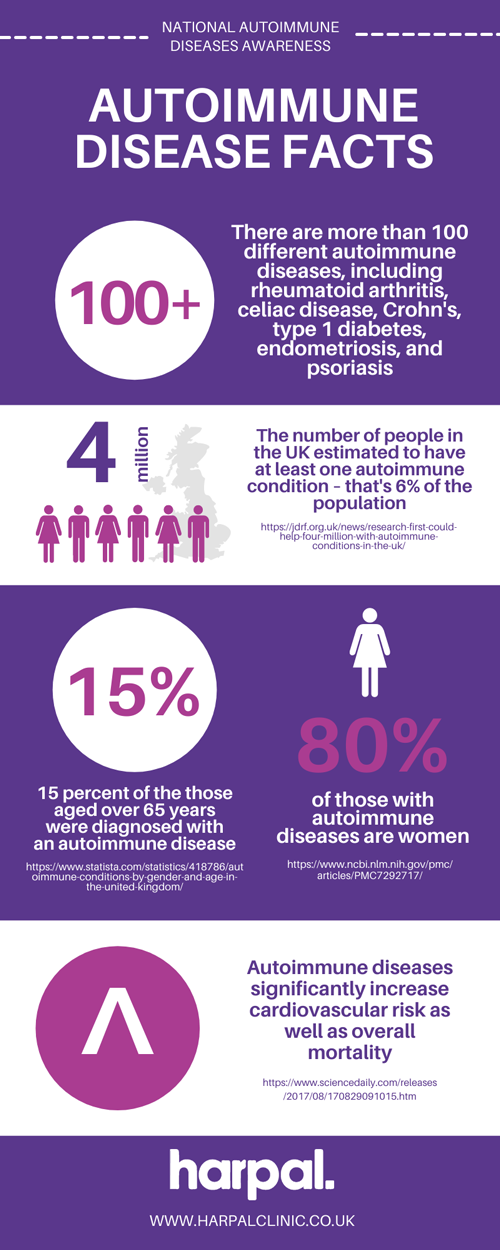
Women are significantly more likely than men to develop autoimmune diseases, accounting for around 78% of autoimmune disease cases.
Hashimoto’s thyroiditis is considered the most common autoimmune disease in women. It occurs when the immune system mistakenly attacks the thyroid gland, which can lead to underactive thyroid function (hypothyroidism).
The first signs of autoimmunity can vary quite significantly depending on the condition. Many people can also experience symptoms that are initially vague or difficult to explain.
These symptoms may develop gradually or appear in episodes, often called flare-ups.
Common early autoimmune disease symptoms include:
These symptoms do not necessarily mean you have an autoimmune disease, as they can occur with many other medical conditions.
Although when well managed people can experience long stretches of time with very few or no symptoms, autoimmune diseases are lifelong (chronic) conditions.
Although there is currently no recognised cure, many autoimmune diseases can be effectively managed with the right treatment and ongoing medical care.
There is no single test that can diagnose every autoimmune condition, which is why obtaining a diagnosis can sometimes take time.
Your doctor may recommend investigations such as:
At Harpal Clinic, our doctors also review your previous NHS or private investigations and, where clinically appropriate, may recommend additional functional or specialist testing to help build a more complete understanding of your health.
Functional testing is not used to diagnose autoimmune disease itself, but it can provide valuable information about other aspects of your health that may be contributing to ongoing symptoms or help guide a personalised treatment plan alongside conventional medical care.
The exact cause of most autoimmune diseases is not fully understood. Research suggests they develop through a combination of genetic susceptibility and environmental factors, rather than a single trigger.
Potential triggers or factors associated with the development or worsening of autoimmune disease include:
Not everyone exposed to these factors will develop an autoimmune disease, and many people develop autoimmunity without an obvious trigger.
LDN is an off-label medication that we commonly prescribe for people with autoimmune and immune-mediated conditions at our clinic.
The response to LDN varies from person to person. Some people notice improvements within the first few weeks, while for others it may take months, or occasionally longer, before any meaningful changes become apparent. There are also people who do not experience a noticeable benefit.
As with any treatment, the response to LDN is individual. Our doctors monitor your progress over time and assess whether it is providing a meaningful improvement in your symptoms and overall health.